
Written by: Azul Cortez
Overview
The non-partisan CHIPS Act (Creating Helpful Incentives to Produce Semiconductors for America Act), launched in September 2023, opens federal funding opportunities for semiconductor materials and manufacturing equipment projects in the United States. This initiative targets projects with capital investments below $300 million, focusing on the construction, expansion, or modernization of commercial facilities crucial for semiconductor manufacturing at the state level. Pragmatically, the CHIPS investment will position the U.S. to produce the materials needed for electric cars, AI infrastructure, and other advanced technologies.
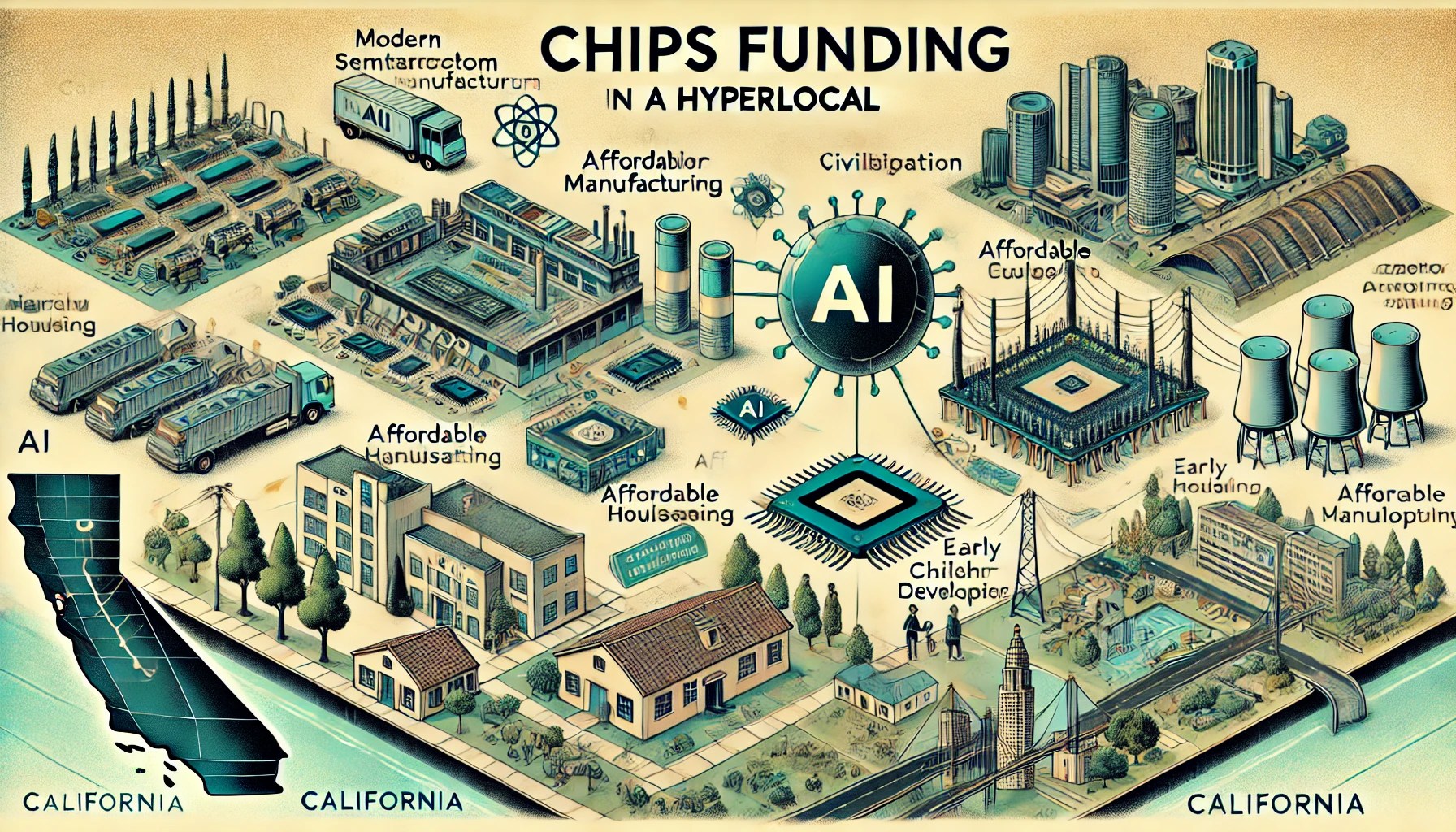
Socially, the advancement of AI can expand fields such as DNA sequencing, aiding in disease prevention, and integrating technology into social services to enhance public infrastructure. CHIPS funding at the state level will create new “Tech Hubs” to rapidly advance the production of semiconductor chips. These emerging “Tech Hubs” are pivotal in producing essential equipment, chemicals, gases, and materials for semiconductor production within the United States. At the hyperlocal level, political considerations of these tech hubs are crucial to regional sustainability in several ways.
Global Context: Canada + EU AI Regulatory Approach & Asia’s Market Dominance
As CHIPS is implemented in the United States, examining the partnership between the European Union (EU) and Canada on AI regulatory sessions (EU-Canada Digital Partnership) provides a crucial case study for the community development and technology business sectors. This partnership offers valuable insights into how nations with a high Human Development Index (HDI) will approach emerging markets of generative AI within the realm of public policy. Notably, countries with HDI figures above 0.8, such as Canada and EU, possess the capital to invest in federal infrastructure to develop AI markets. The likelihood of the United States aligning with Canada & EU’s global AI regulatory policy recommendations is high – given historical political alignments with the EU and Canada such as NAFTA and Paris Agreement. Strong trade relationships further reinforce this alignment, making social impact-driven AI regulations at national and state levels particularly relevant for the federal, state-level and hyper-local outcomes.
In Asia, countries like Taiwan lead in global semiconductor chip production. The company Nvidia and Taiwan Semiconductor Manufacturing Company (TSMC) are the leading producer of semi-conductor chips and have led innovations and the implementation of AI. International business and collaborations between Nvidia and Google DeepMind open new opportunities for modeling the flow of upcoming investments and potential social impact frameworks. However, Google and other U.S. based companies have express public dissatisfaction with the lack of state and local national infrastructure to produce semi-conductor chips and how it will impact the political relevance of the U.S.
In August 2023, the US Chamber of Commerce highlighted the need to prioritize funding for the ‘science half’ of the CHIPS and Science Act. This underscores the importance of quick deployment of CHIPS resources at the State and local level to build Tech Hubs and enhance domestic research and development.
In summary, three major opportunities to track at the Global-Level:
- European Union and Canada’s Digital Partnership: Outlining collaborative research opportunities in cutting-edge semiconductor technologies, closely following the development and deployment of AI public policy, as well as the regulation and collaboration on AI innovations for their earth system modeling to track climate changes.
- The rollout of CHIPS infrastructure funding in the United States: Carving out tech innovation hubs at the state & hyper-local level to increase domestic market relevance and securing semiconductor supply chains.
- The evolving multi-national information trading approach: The implementation of developments in public policy in the EU, Canada, and the United States can strengthen trade relationships with Taiwan, South Korea, and China to promote harmony
Considerations at the Hyper-local Level:
The CHIPS Act, as it stands, incorporates economic development principles and conventional philanthropic points of interest, including climate considerations, workforce initiatives, and the development of affordable housing and early childcare centers in rural areas of the U.S. These initiatives diversify markets at the hyperlocal level and contribute to equitable solutions in multiple ways. From a social impact perspective, philanthropic and private social investors with national influence can further accelerate the deployment of funding to address hyperlocal infrastructure needs related to production, scaling, and climate resilience.
Points of interest at the Hyper-local level include:
- Job Creation: The construction and expansion of semiconductor manufacturing facilities will create numerous jobs, both directly in manufacturing and indirectly in supporting industries such as construction, logistics, and services. This can lead to significant economic growth in local communities where these facilities are built.
- Economic Development: Increased investment in semiconductor manufacturing can spur local economic development. Local businesses, including suppliers, service providers, and retailers, may benefit from increased demand. The presence of high-tech manufacturing facilities can also attract other businesses and industries to the area, creating a more diverse and resilient local economy.
- Infrastructure Improvements: The development of semiconductor facilities often necessitates improvements in local infrastructure, such as transportation networks, utilities, and communication systems. These improvements can have long-term benefits for the community, enhancing the quality of life and making the area more attractive for future investments.
- Educational and Training Opportunities: The CHIPS Act includes provisions for workforce development, including training programs to prepare workers for jobs in the semiconductor industry. Local educational institutions, such as community colleges and technical schools, may receive funding to develop and offer these programs, providing residents with new skills and career opportunities.
- Innovation and Research Hubs: The act encourages collaboration between semiconductor companies, research institutions, and universities. This can lead to the establishment of innovation and research hubs in local communities, fostering a culture of innovation and providing opportunities for local researchers, students, and entrepreneurs.
- Increased Local Revenues: The establishment of semiconductor manufacturing facilities can increase local tax revenues through property taxes, business taxes, and increased consumer spending. These additional revenues can be used to improve public services and infrastructure in the community.
- Environmental Considerations: Local communities may also see environmental impacts, both positive and negative. The construction and operation of semiconductor facilities can lead to concerns about energy use, water consumption, and waste management. However, new facilities often incorporate advanced technologies to minimize environmental impact, and local regulations can ensure sustainable practices.
- Community Engagement: Companies benefiting from the CHIPS Act may engage with local communities through corporate social responsibility (CSR) initiatives. This can include investments in local projects, partnerships with community organizations, and efforts to address community needs and priorities.
Blue Lamb Ventures Recommendations for Equitable Community Development Policies at the State Level to Drive Hyper-Local Impact
Diversity policies at the state level are crucial for ensuring that the hyper-local outcomes of the CHIPS Act rollout are equitable and inclusive. By prioritizing diversity in workforce development, state policies can create opportunities for underrepresented communities to participate in the burgeoning semiconductor industry. This inclusivity helps to build a more resilient local economy, as a diverse workforce brings varied perspectives, innovative ideas, and a broader range of skills. Additionally, equitable access to jobs and training programs can reduce economic disparities and promote social cohesion within local communities. Furthermore, by addressing the specific needs of minority and underserved populations through targeted initiatives, states can ensure that the benefits of economic growth and technological advancement are widely shared, leading to sustainable and comprehensive community development.
Blue Lamb Venture’s recommendations include:
Inclusive Workforce Development Programs
- Training and Education: State agencies should require partnerships with community colleges, technical schools, and universities to create specialized training programs tailored to semiconductor manufacturing and related fields. These programs should be accessible to underrepresented and underserved communities.
- Scholarships and Grants: Private entities and public agencies can work together to provide scholarships and grants to students from diverse backgrounds to encourage their participation in STEM (Science, Technology, Engineering, and Mathematics) education and training programs.
- Apprenticeships and Internships: Develop apprenticeship and internship programs with local semiconductor companies to offer hands-on experience and career pathways for individuals from diverse backgrounds.
Targeted Recruitment & Community Engagement
- Diversity Goals: Set clear diversity and inclusion goals for hiring in semiconductor manufacturing facilities. Encourage companies to adopt hiring practices that prioritize diversity and inclusion, special emphasis on women of color, BIPOC, LGBTQI, Disabled Veterans and so on.
- Community Outreach: Conduct outreach programs in underserved and minority communities to raise awareness about career opportunities in the semiconductor industry and the available training programs.
- Partnerships with grass-roots organizations: Collaborate with BIPOC organizations and community groups to identify and recruit potential candidates for training programs and job openings.
Supportive Infrastructure and Services - Affordable Housing and Co-location considerations: Invest in the development of affordable housing near semiconductor manufacturing hubs to ensure that workers from diverse backgrounds can afford to live close to their workplaces.
- Childcare Services: Provide accessible and affordable childcare services for workers in the semiconductor industry, especially targeting low-income families and single parents.
- Transportation: Improve public transportation options to ensure that workers from all communities can easily commute to semiconductor manufacturing facilities.
Equitable Economic Development
- Small Business Support: Offer grants and low-interest loans to BIPOC small businesses that can become suppliers or service providers for the semiconductor industry.
- Community Benefits Agreements: Establish community benefits agreements with semiconductor companies to ensure that local communities benefit directly from the economic development projects, including commitments to local hiring and investment in community projects.
2. Local Hiring Requirements: Implement policies that require a certain percentage of hires for semiconductor projects to come from the local community, with a focus on underrepresented groups.
Continuous Monitoring and Evaluation - Metrics and Accountability: Develop metrics to track diversity and inclusion efforts in the workforce, and hold companies accountable for meeting diversity goals.
- Feedback Mechanisms: Create feedback mechanisms for employees and local constituents to report issues related to diversity, inclusion, and equity, and ensure that these issues are addressed promptly.
- Regular Reporting: Require regular reporting from companies on their progress towards achieving equitable workforce development and community benefits at the hyper-local level.
Conclusion:
The CHIPS Act represents a significant step forward in bolstering the United States’ semiconductor industry, with wide-reaching implications at the global, national, and hyperlocal levels. By fostering job creation, economic development, and innovation, the act can help build resilient local economies while addressing crucial infrastructure and environmental needs nationally. As the U.S. aligns with international partners like the EU and Canada, and engages with leading semiconductor nations like Taiwan and South Korea, the potential for technological advancements and economic growth is immense. If done intentionally, strategic investments and collaborative efforts under the CHIPS Act can pave the way for a more secure, innovative, and sustainable future.
References:
- Ashley Belanger, (2023, November 29). Nvidia CEO: US chip independence may take 20 years to achieve. Ars Technica. https://arstechnica.com/tech-policy/2023/11/nvidia-ceo-us-chip-independence-may-take-20-years-to-achieve/
- Biden-Harris Administration announces Chips for America funding opportunity to strengthen semiconductor supply chains. U.S. Department of Commerce. (2023, September 29). https://www.commerce.gov/news/press-releases/2023/09/biden-harris-administration-announces-chips-america-funding-opportunity#:~:text=%E2%80%9CThe%20CHIPS%20and%20Science%20Act,Secretary%20of%20Commerce%20Gina%20Raimondo.
- Canada – European Union Digital Partnership. Shaping Europe’s digital future. (2023, November 24). https://digital-strategy.ec.europa.eu/en/news/canada-european-union-digital-partnership
- Edwards, C. Google cloud and Nvidia expand partnership to advance AI computing, software and services. NVIDIA Newsroom. (2023, August 29) https://nvidianews.nvidia.com/news/google-cloud-and-nvidia-expand-partnership-to-advance-ai-computing-software-and-services
 Blue Lamb Ventures